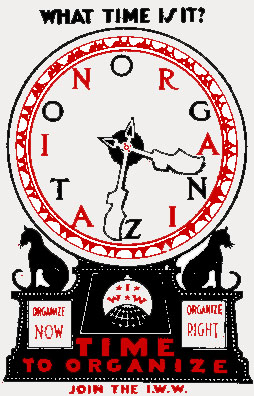
Como oportunamente relembra a
Raquel, os Wobblies foram fundados há 106 anos. Aqui fica um excerto de um texto em inglês, escrito originalmente em italiano por Sergio Bologna, que sugere um exercício comparativo entre a tradição das lutas operárias norte-americanas e a das suas congéneres europeias :
In 1905, at the peak of the struggle, while the Soviets were coming into being in Russia, in the USA the International Workers of the World (IWW) was formed; the most radical proletarian organisation ever in the USA, the only revolutionary class organisation before the rise of the Afro-American movement. Today there is much to be said and learned from the IWW. Although many of its militants were anarchists and anarcho-syndicalists who had migrated to the US from Eastern and Western Europe, the IWW cannot merely be written off as the American equivalent of French anarcho-syndicalism.
What was there in the IWW that is so extraordinarily modern? Although it was based on an old class nucleus, the Western Federation of Miners, the merit of the IWW was that it attempted to organise the American proletariat in terms of its intrinsic characteristics. It was primarily an immigrant proletariat, and therefore a mixture of ethnic groups which could only be organised in a certain way. Secondly, it was a mobile proletariat, a fact which very much militated against identification with any particular job or skill, and which also militated against workers developing ties to individual factories (even if only to take them over).
The IWW made the notion of the social factory a concrete reality, and it built on the extraordinary level of communication and coordination possible within the struggles of a mobile workforce. The IWW succeeded in creating an absolutely original type of agitator: not the mole digging for decades within the single factory or proletarian neighbourhood, but the type of agitator who swims within the stream of proletarian struggles, who moves from one end to the other of the enormous American continent and who rides the seismic wave of the struggle, overcoming national boundaries and sailing the oceans before organising conventions to found sister organisations. The Wobblies' concern with transportation workers and longshoremen, their constant determination to strike at capital as an international market, their intuitive understanding of the mobile proletariat - employed today, unemployed tomorrow - as a virus of social insubordination, as the agent of the "social wildcat": all these things make the IWW a class organisation which anticipated present-day forms of struggle, and was completely independent of the tradition of the Second and the Third Internationals. The IWW is the direct link from Marx's First International to the post-communist era.